
Edit photos, layered PSD projects, RAW files and vector graphics directly in your browser.
Photopea is a browser-based image editor built for people who want advanced photo and graphic design tools without installing a large desktop application. It can handle quick image changes as well as layered projects, making it useful for photo retouching, social graphics, web assets, mockups, illustrations, and PSD-based workflows.
What makes Photopea different from many lightweight online editors is the depth of its workspace. Instead of limiting you to presets and one-click effects, it provides familiar tools for selections, layers, masks, paths, blending, adjustment layers, vector shapes, typography, and detailed color corrections.
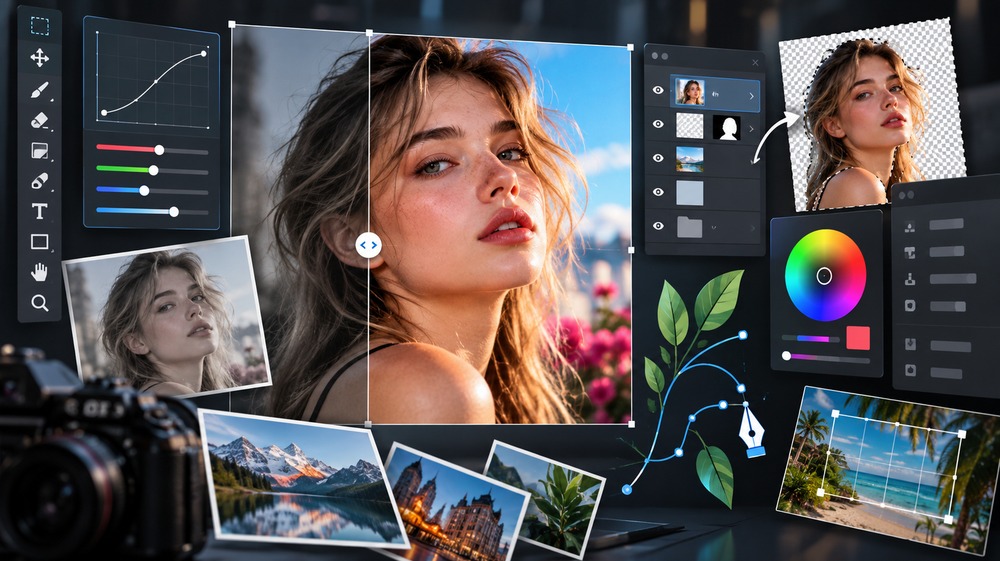
Photopea is an advanced online editor for raster and vector graphics that runs directly in a web browser. It can be used for basic jobs such as resizing or cropping an image, but it is also designed for more involved work such as editing layered compositions, retouching photographs, creating graphics, preparing website visuals, and working with reusable design files.
PSD compatibility is one of Photopea's most useful features. You can open a layered project, adjust text, move elements, modify masks, change colors, update smart objects, and save the project again as PSD. This is especially convenient when you receive an editable design file but do not want to install another graphics application just to make a few changes.
Photopea keeps design elements separated through layers. That means text, photographs, effects, shapes, and backgrounds can stay editable instead of being permanently flattened into one image.
For photography, Photopea includes the core controls expected from a serious editor. You can correct exposure, contrast and color, remove unwanted details, sharpen selected areas, blur backgrounds, transform subjects, and combine multiple images into one composition.
Levels, curves, hue and saturation, brightness and contrast, blur effects, sharpening, liquify-style adjustments and other filters make it possible to move beyond simple presets. These tools are useful when an image needs targeted correction rather than a single global filter.
Selections let you isolate a specific part of an image before making changes. Masks can then hide or reveal areas without deleting the original pixels, which makes later revisions much easier.
Photopea can open a range of camera RAW formats, including formats used by major camera systems. RAW editing is useful when you want more control over exposure, color balance, highlights and shadows before continuing with detailed retouching or export.
Photopea is not limited to pixel-based images. Its vector workflow includes paths, vector masks and shape layers, which are useful for logos, icons, interface graphics, simple illustrations and scalable design elements.
Photopea also includes AI-assisted features for selected editing tasks. These tools can speed up jobs that would otherwise require careful manual selections, such as removing a background or replacing a selected part of an image with newly generated content based on a text description.
Photopea supports a wide range of file types, which makes it practical when assets come from different programs or devices. Along with PSD, it can work with familiar formats such as JPG, PNG, GIF, BMP, WEBP, SVG and PDF, plus design and camera formats such as AI, EPS, TIFF, HEIC and multiple RAW types.
This broad compatibility is useful for mixed workflows: you can open an editable source file, make changes, then export a web-ready version without rebuilding the artwork in another program.
Because Photopea runs in a browser, it can work across different device types. A larger screen, keyboard and precise pointing device usually provide the most comfortable experience for complex editing, while tablets and phones can still be useful for lighter changes and quick exports.
Photopea can be used as a free online editor. The free experience is supported by advertising, while account and paid options may be available for users who want a different experience or want to support the service.
Yes. PSD is the main editable document format used by Photopea, and the editor is designed to open and save layered PSD files.
Photopea states that its standard editing workflow runs on your device and that files do not need to be uploaded just to open and edit them. This can be useful when you prefer a browser editor but still want local handling of ordinary project files.
Yes. Photopea supports several RAW formats from popular camera systems and provides controls for exposure, color balance, contrast, highlights and shadows.
No. In addition to raster image editing, Photopea includes vector tools, text, shapes, paths, masks and layout features that make it useful for graphic design and mixed-media projects.
Photopea is a strong choice when you need more than a simple online image editor but still want the convenience of working in a browser. Its combination of PSD support, layers, masks, RAW processing, vector tools, filters, AI-assisted features and broad file compatibility makes it suitable for both quick edits and detailed creative projects.


